
Analyze with AI
Get AI-powered insights from this Mad Devs article:
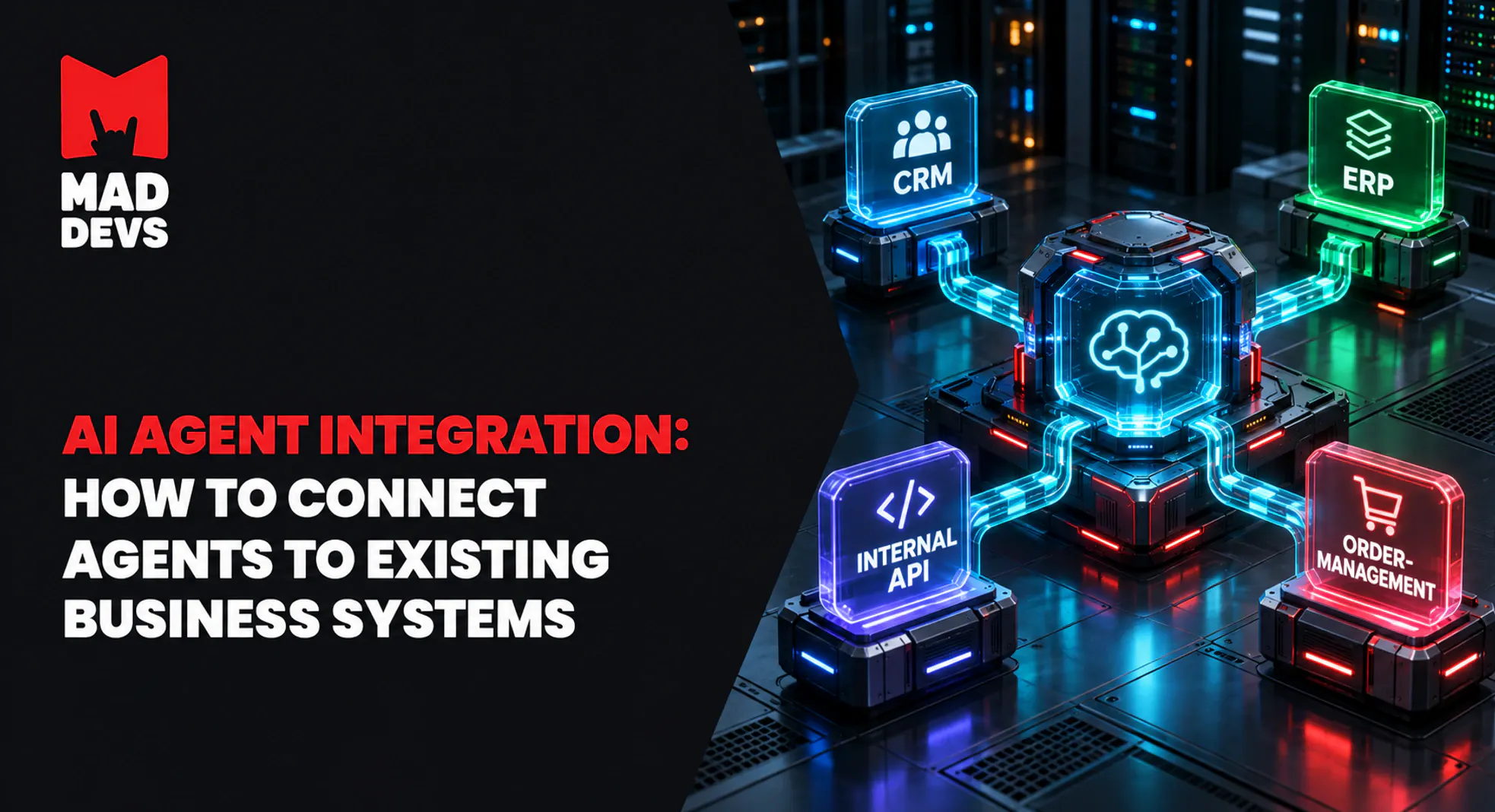
AI agent integration becomes difficult when a simple request crosses several systems. For an order change, customer details may be in CRM, the current order in order management, and fulfillment constraints in ERP. The agent needs dependable ways to read authoritative data, execute approved actions, and recognize whether the complete process succeeded.
The question is not “How many tools can we connect?” but “Which business capabilities should we expose, through which patterns, with what guarantees?” This guide helps assess infrastructure, choose an architecture, and estimate complexity without rebuilding working systems. It also identifies workflows where deterministic automation is sufficient and an agent would add unnecessary complexity.
Key takeaways
- Start with the business workflow, systems of record, and failure conditions—not an AI framework.
- Direct APIs, middleware, MCP-based tools, and event-driven integrations solve different problems and often coexist in one workflow.
- Expose bounded business capabilities such as get_order_status or request_address_change, rather than giving an agent arbitrary access to internal data and endpoints.
- Multi-system workflows need explicit handling for timeouts, retries, duplicate requests, delayed results, and partial completion.
- Integration cost depends more on API quality, data consistency, business dependencies, and required guarantees than on the number of connected systems alone.
What does AI agent integration with business systems actually involve?
AI agent integration is the controlled connection of an agent and its orchestration layer to the data and operations of existing business applications. The integration boundary translates an agent’s intended action into a deterministic system call and returns a structured result that the workflow can verify.
The boundary supports three distinct responsibilities:
- Data access: Retrieve the minimum current information required for a decision from the correct source of truth.
- Action execution: Submit a bounded write operation, such as reserving inventory or updating an approved address.
- Cross-system orchestration: Coordinate dependent, independent, or long-running operations and determine the overall workflow state.
Keeping them separate matters. A successful CRM lookup does not prove that an ERP update occurred, while database access does not automatically provide a safe business operation. Enterprise reference architectures similarly separate orchestration and backend access (Google Cloud, AWS).
What should you assess before integrating AI agents?
Assess the complete business path before selecting integration technology. The useful unit of analysis is not an application list; it is a workflow map showing inputs, authoritative systems, actions, dependencies, and terminal states.
Existing systems and available APIs
Inventory every application, service, and database involved. Record its interfaces, authentication, rate limits, version policy, test-environment availability, and owner. Validate documentation with representative non-production requests. An API with incomplete schemas, unstable identifiers, or no test environment is not a low-effort integration.
Identify where an adapter must turn a technical endpoint into a business capability. An arbitrary record-update endpoint is a poor agent tool. A service that validates request_order_address_change creates a narrower, testable contract.
Data availability and quality
Name the source of truth for every required field and test whether records agree across systems. Check freshness, missing values, duplicate IDs, incompatible formats, and synchronization delays. Trace each field in sanitized workflow cases back to its owner.
Do not let the agent reconcile conflicts through guesswork. Define precedence rules or synchronize data first. If order management owns order status, make that explicit.
Business actions and workflow dependencies
List what the agent must do. Mark sequential and independent steps, human approvals, and work that may outlive the interaction. Define the expected result and failure outcome for each action.
Test adverse cases: What if validation succeeds but the write times out? Can it be queried by an idempotency key? What if a result arrives five minutes later? These questions reveal needs a happy-path demo misses.
Integration constraints
Record legacy protocols, maintenance windows, latency, network boundaries, vendor support, and owners. Access constraints affect exposed capabilities; the Mad Devs guide to AI agent security covers those controls.
The number of systems is not a reliable complexity measure. Three undocumented, tightly coupled applications can demand more engineering than ten stable services with consistent APIs and identifiers.
Which AI agent integration architecture should you choose?
Choose an approach per operation, based on interface quality, dependency structure, response time, and maintenance needs. The following AI Agent Integration Decision Matrix is a planning tool for this assessment, not a universal industry standard.
| Integration approach | Best fit | API availability | Systems and workflow | Latency | Maintenance effort | Main limitation |
|---|---|---|---|---|---|---|
| Direct API | Simple, bounded integrations | Stable, documented API | Few systems; short synchronous path | Immediate response needed | Low initially; rises with every point-to-point dependency | Coupling and change management as integrations grow |
| Middleware / API gateway | Heterogeneous systems that need one controlled interface | Mixed APIs or transformation required | Several systems; shared policies and mappings | Small additional hop is acceptable | Central layer needs ownership, monitoring, and versioning | Additional integration infrastructure |
| MCP-based tools | Consistent agent-to-tool discovery and invocation | Backend capability can be wrapped as a tool | Multiple agents or tool providers benefit from a common contract | Depends on the tool’s backend path | Tool schemas and servers still need lifecycle governance | Does not remove adapters or backend engineering |
| Event-driven integration | Long-running, bursty, or asynchronous operations | Events, queues, or job interfaces available | Work continues beyond one agent turn | Immediate completion is unnecessary | Requires durable state, correlation, consumers, and replay policy | Eventual consistency and more complex status tracking |
Direct API integration
Direct integration works when a bounded workflow uses a few reliable, well-documented APIs. It minimizes infrastructure and can provide a straightforward synchronous result.
Its weakness is accumulated coupling: the agent layer collects authentication differences, vendor schemas, transformations, and error semantics. Prototype the complete workflow and confirm versioning, idempotency, rate limits, and errors. For evolving interfaces, an API-first approach can establish testable contracts.
Integration middleware and API gateways
Middleware fits incompatible system formats or business operations shared by several workflows. It can centralize routing, schema transformation, authentication enforcement, throttling, and observability while keeping vendor-specific details outside the agent.
The trade-off is a new production component with owners and versioned contracts. Test whether the adapter can absorb a representative backend schema change while the agent-facing capability remains stable. Custom APIs or modernization may require dedicated backend development.
MCP-based tool integration
Model Context Protocol (MCP) is an open standard for connecting AI applications to external systems. It can reduce agent-side variation by presenting capabilities through consistent tool contracts. Google Cloud’s reference architecture uses MCP servers as an anti-corruption layer between orchestration and backends (Google Cloud).
MCP is not mandatory, and it does not make an unreliable backend reliable. Teams must still design bounded capabilities, implement adapters, validate inputs, manage authorization, version schemas, and monitor execution. Test an MCP option by inspecting the tool contract and tracing a call to its final system of record. If the server merely republishes a broad internal API, standardization has not solved the business-boundary problem.
Event-driven and asynchronous integration
Use an event or job-based pattern when an operation may outlive an agent interaction. The agent submits a command with a correlation ID; a durable component tracks progress and consumes completion or failure events.
“Accepted” must not be presented as “completed.” Define where status lives, how late or duplicate events are handled, how the caller receives the result, and when a stalled operation escalates. Event-driven integration trades immediate consistency for decoupling and resilience, so the business must accept that state may be temporarily different across systems.
How to orchestrate AI agent actions across multiple systems
Orchestration should encode dependencies and completion rules explicitly rather than relying on the model to infer them during each run.
Sequential workflows apply when each step requires a verified previous result. Retrieving an order, checking ERP restrictions, and submitting a permitted change is sequential.
Parallel workflows apply to independent operations. An audit record and customer notification might run concurrently, but each branch needs its own result and timeout.
Asynchronous workflows continue outside the agent session. A durable orchestrator—not conversational memory—must retain state, deadlines, and callback or polling rules.
Across all three, design for these integration-specific conditions:
- Set timeouts by operation and distinguish “failed” from “outcome unknown.”
- Retry only transient failures and use backoff; do not retry a non-idempotent write blindly.
- Attach idempotency or request keys so repeated calls cannot create duplicate business actions.
- Persist step-level state so partial completion can be detected after a restart.
- Check final state in systems of record instead of trusting a fluent agent response.
- Define compensation where a safe inverse action exists, or escalate when it does not.
Measure the integration at workflow boundaries, not by whether the agent produced a plausible response. Useful operational metrics include the percentage of workflows that reach a verified terminal state, partial-completion and duplicate-action rates, end-to-end latency by workflow type, timeout and retry rates by dependency, and time to reconcile or escalate an unknown outcome. Set targets from the process’s business impact and current baseline; a low-consequence lookup and an order-changing workflow should not share the same thresholds.
Suppose the agent updates an order flag in CRM, but ERP does not confirm synchronization. The workflow is not complete. The orchestrator should store that CRM succeeded and ERP remains pending or unknown, query ERP using the same correlation key, and retry only if the operation is safe. If the deadline expires, it can reverse the CRM update when the business supports compensation or create a human task with the exact partial state. The customer should receive a pending or escalated status, not a false confirmation.
Salesforce’s architecture guidance likewise treats sequencing, parallel execution, asynchronous invocation, idempotency, and compensation for mismatched cross-platform state as separate integration concerns (Salesforce Architects). Broader evaluation of task success and final-state checks belongs in an AI agent reliability program.
How to integrate AI agents with legacy systems
Legacy integration usually requires a controlled interface, not a full rebuild. An adapter can translate a modern capability into an older protocol; a wrapper can expose a narrow operation; middleware can transform records and isolate fragile connectivity.
Build the smallest interface that supports the workflow and test production-like volume and failures. Avoid database writes that bypass business rules. UI automation may be a last resort, but its sensitivity to screen changes makes it a weak permanent interface.
Selective modernization—such as adding stable identifiers, a query endpoint, or a change event—can unlock the workflow while preserving critical business logic. Rebuild only when existing interfaces cannot meet required guarantees.
What makes enterprise AI agent integration expensive or complex?
Complexity grows when engineers must reconstruct missing contracts, reconcile data, coordinate state, or guarantee outcomes across organizational boundaries. Use this Integration Complexity Matrix during discovery:
| Factor | Lower complexity | Higher complexity | Cost implication |
|---|---|---|---|
| System interfaces | Documented, versioned, tested APIs | Undocumented protocols, database access, or UI-only paths | More adapter development and regression testing |
| Data | One clear source of truth and shared IDs | Duplicates, stale copies, conflicting formats | Mapping, cleansing, synchronization, and exception handling |
| Business logic | Bounded actions with explicit rules | Rules distributed across people and applications | More discovery, validation, and acceptance scenarios |
| Cross-system actions | Few independent reads or idempotent writes | Long dependent chains and non-reversible writes | Durable orchestration, compensation, and escalation paths |
| Response requirements | Delayed results are acceptable | Strict interactive latency across slow dependencies | Caching, performance work, and fallback design |
| Reliability | Best-effort, low-consequence task | Auditable completion with high operational impact | Monitoring, state verification, replay controls, and broader testing |
| Maintenance | Stable interfaces with clear owners | Frequent vendor changes and unclear ownership | Ongoing contract updates and operational coordination |
Estimate effort with a workflow diagram, interface inventory, sample payloads, dependency map, and failure scenarios. Three systems can cost more than ten because difficult interfaces and transactional dependencies dominate raw count. Avoid universal estimates before discovery.
Example: connecting an AI agent to CRM, ERP, and order management
Consider a hypothetical customer request to change an order address. This is an architectural illustration, not a Mad Devs client case.
- The agent calls a customer lookup capability backed by CRM.
- It retrieves the current order and status from order management, the source of truth for fulfillment state.
- It queries ERP restrictions, such as whether the destination is compatible with the fulfillment plan.
- A policy service combines verified facts and returns allowed changes; the agent prepares the option for confirmation if required.
- After confirmation, the agent sends request_order_address_change with an idempotency key through the integration layer.
- Order management accepts the command and returns a workflow ID. ERP synchronization continues asynchronously.
- The orchestrator waits for the ERP result, verifies final state, and only then triggers the customer confirmation.
CRM lookup and order retrieval may run in parallel. Eligibility and the write are sequential; ERP synchronization is asynchronous. Middleware normalizes IDs, while an event bus carries updates. The durable workflow record determines completion.
Failures include ambiguous matches, stale data, rate limits, or a write timeout with an unknown outcome. The architecture must preserve correlation IDs and step results so it can resume without repeating a completed write.
Mad Devs describes workflow analysis, integration-point mapping, API documentation, and test-scenario design as part of its custom AI agent development process. Those practices support this kind of discovery, but they do not imply that the hypothetical implementation above is a published client project.
AI agent integration readiness checklist
- Is the business workflow clearly defined, including its terminal states?
- Which existing systems must participate, and which owns each data item?
- Are their APIs documented, accessible, versioned, and testable?
- Is the required data current, consistent, and linked by stable identifiers?
- Which operations require read access, write access, or human approval?
- Which pattern—direct API, middleware, MCP-based tool, or event-driven—fits each operation?
- Can the workflow distinguish failed, delayed, and unknown responses?
- Are retries limited to safe operations, and are duplicate actions controlled?
- Can the system detect and record partial completion?
- Are compensation and human escalation paths defined?
- Are final-state validation and acceptance criteria documented?
- Is maintenance and incident ownership established for every integration?
- Are implementation costs, vendor dependencies, and interface modernization needs understood?
The right integration architecture follows from the business outcome and constraints of existing systems, not from the popularity of an AI framework. A narrow, verifiable capability on a dependable interface is more valuable than a large catalog of tools the workflow cannot safely coordinate.
FAQ
What is AI agent integration?
How do AI agents integrate with existing enterprise systems?
Can AI agents connect to legacy applications?
Do AI agents require MCP for integration?
What makes AI agent integration complex or expensive?
Latest articles here