AI-assisted technical audit for an MES provider
Mad Devs conducted an AI-assisted technical audit for an enterprise provider of manufacturing execution systems (MES) and industrial automation solutions. AI tools helped analyze documentation, interview transcripts, and code, flagging areas for expert review. The team delivered a four-phase roadmap for change over the next one to three years.
Overview
The client develops its own software platform for manufacturing companies, implements it at customer sites, and adapts it to each customer’s requirements.
Mad Devs conducted an independent technical audit for an enterprise provider of manufacturing execution systems (MES) and industrial automation software. The review covered the client’s development organization, product code, infrastructure, and operational processes. Its findings were compiled into a prioritized roadmap for the company’s next stage of growth.
Results at a glance
3.5 months
Audit duration
10 sessions
More than 13 hours of interviews across the organization
180+ criteria
Used in the audit checklist
40+ recommendations
Prioritized across four levels
~20 risks
Assessed by likelihood and impact
100+ pages
In the final report
The business challenge
The client’s engineering team was balancing two demands: weekly releases of the core product and a steady stream of custom development for manufacturing customers. Processes had evolved as the business grew, but leadership needed to know whether they could support this workload without slowing delivery or reducing quality.
The audit focused on four questions:
- Where were work management and delivery processes inefficient?
- How could the client improve code quality and maintainability while preserving development speed?
- Did the team’s structure match its current workload and long-term plans?
- What changes would help the organization scale over the next one to three years?
The leadership team also brought nearly 20 strategic questions about processes, roles, staffing, and the balance between speed and quality.
How Mad Devs approached the audit
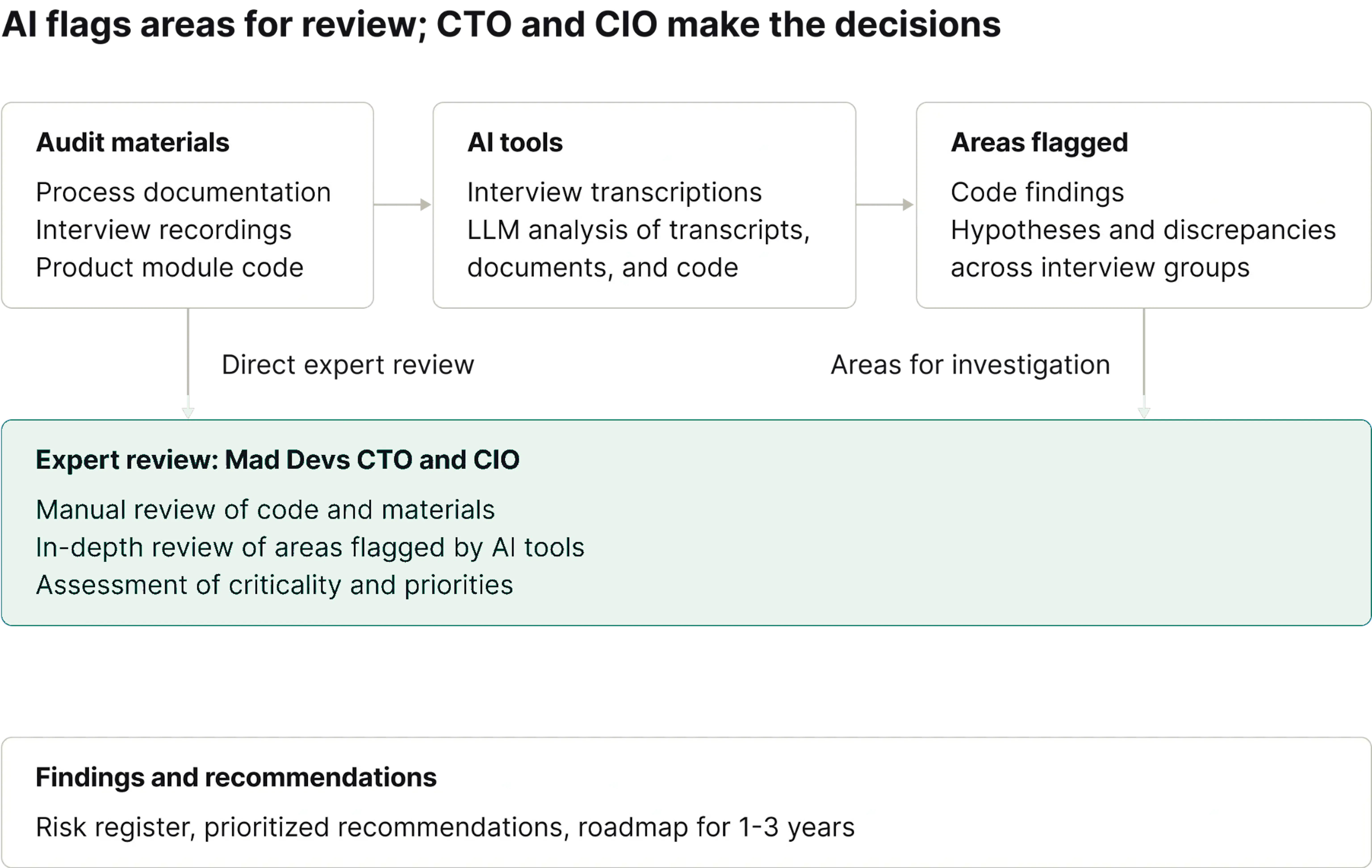
Mad Devs’ CTO, CIO, and Delivery Manager translated the audit goals into criteria, interview scenarios, and areas for investigation. The team reviewed documentation, interviewed people across the organization, and analyzed a representative product module alongside development and delivery processes.
AI tools helped process the volume of documentation, interview transcripts, and code, and flagged areas for closer review. Mad Devs’ experts checked those signals against source materials, investigated relevant findings, and determined their significance and priority. The Delivery Manager coordinated the audit, facilitated sessions with the client’s team, and assembled the final report.
The work moved through five connected stages:

Preparation
Mad Devs turned the client’s goals and questions into an audit checklist of more than 180 criteria covering processes, code quality, team structure, and readiness to grow. The team also created a separate repository checklist. AI helped adapt the criteria to the client’s industry and develop “what if” scenarios to test how the organization might handle growth. Interview guides with hypotheses to investigate were prepared for each participant group.

Documentation review
The team reviewed technical and business documentation for development, project management, and support. They compared the documented procedures with how teams worked in practice.

Interviews
The team held 10 sessions, totaling more than 13 hours, with people across the organization, including leadership, developers, project managers, and support staff. AI transcription tools converted recordings into transcripts, which LLMs analyzed individually. The team then compared perspectives across groups to identify discrepancies and test the audit hypotheses.

Code analysis
We selected a representative product module for review. AI tools conducted an initial check against the repository checklist. Mad Devs’ CTO and CIO then reviewed the code themselves and investigated areas the tools had flagged for closer examination.

Process and tool analysis
Mad Devs examined the development lifecycle, task definition and prioritization, communication between teams, releases, and deployments. The team assessed how these practices aligned with the client’s internal procedures and relevant industry practices.

Reporting and presentation
We presented an interim report to the client’s leadership and revised it based on their feedback. After delivering the final report, the team answered additional client questions in a separate document with recommendations.
Technology and audit tools
The client’s product was built on Microsoft technologies: Windows Server, Microsoft SQL Server, and .NET services for integrations with industrial equipment and enterprise systems. Manufacturing users accessed the product through a web application, deployed on customer infrastructure.
For analysis, Mad Devs used Claude and DeepSeek to support checklist and interview-scenario preparation, review transcripts, documentation, and code, and assemble report materials. AI transcription tools were used to transcribe interviews. The client-specific audit checklist contained more than 180 criteria adapted to its industry and technology stack.
What the audit covered
The audit examined how technical conditions, delivery practices, and team operations affected product quality and the organization’s readiness to grow.
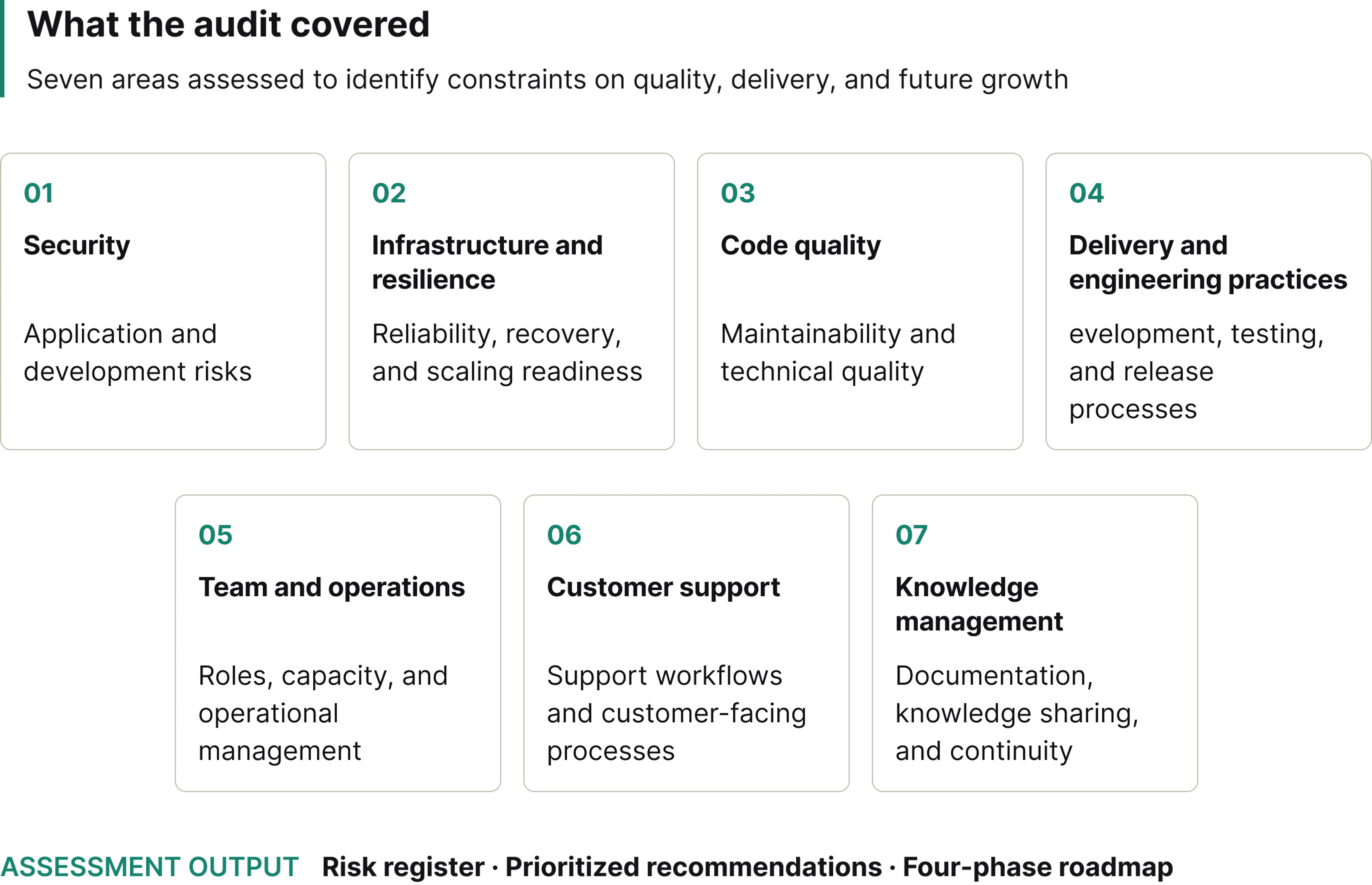
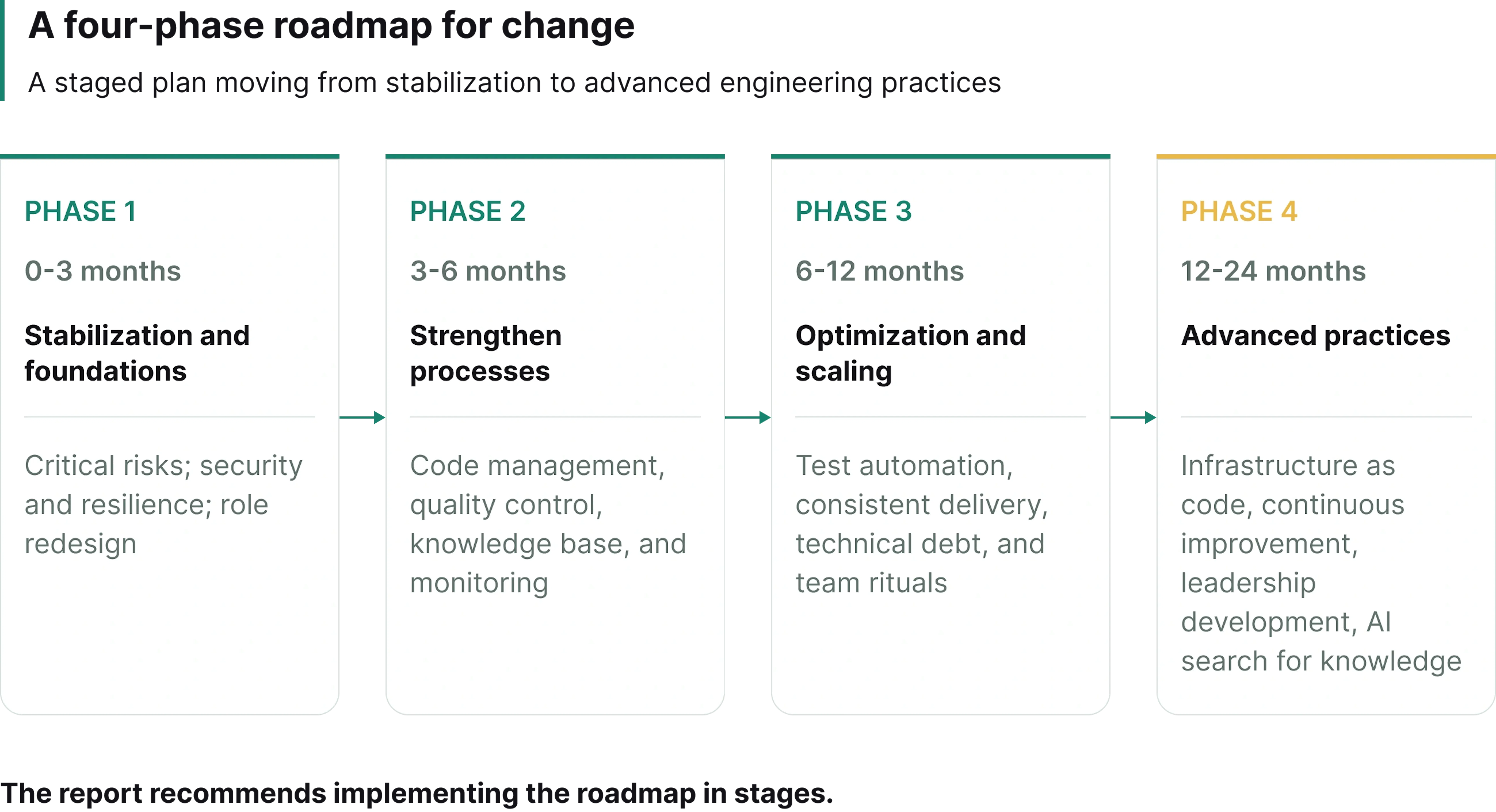
Across these areas, Mad Devs connected technical findings with constraints in delivery and team operations. The risk register and four priority levels helped the leadership team distinguish issues requiring prompt attention from longer-term improvements. A phased roadmap then translated the recommendations into a sequence: address security and resilience, strengthen engineering processes, optimize delivery, and introduce more advanced practices.
The recommendations also addressed team capacity. By redistributing responsibilities, the client could free up developer time without additional hiring. Together, the findings and roadmap gave leadership a practical basis for deciding what to address first and how to support growth with the existing team.
Key results
- More than 40 recommendations across four priority levels, helping the client distinguish urgent actions from longer-term improvements.
- A risk register of approximately 20 items, assessed by likelihood and impact to help prioritize follow-up.
- Answers to nearly 20 strategic questions about process effectiveness, team roles, staffing, and the balance between speed and quality.
- Recommendations for redistributing team responsibilities to free up development capacity without additional hiring.
- A four-phase roadmap moving from stabilization to advanced engineering practices, with detailed phases spanning 24 months within the broader one-to-three-year planning horizon.
Engineering readiness across product and customer work
By reviewing technical findings alongside delivery processes and team structure, Mad Devs helped the client assess its engineering organization in the context of its growth plans.
A broad audit helps leadership understand how the engineering organization works as a whole. Teams may also need ongoing visibility into code-level risks as repositories change between reviews. Enji Guard supports that scenario with continuous repository checks.
|
Keep repository risks visible as code changes Enji Guard checks repositories for security vulnerabilities, dependency risks, testing gaps, and maintainability issues. It surfaces actionable findings to help teams decide what to address as development continues. Get a repo readiness report → |
For this MES provider, growth depended on strengthening engineering practices while keeping its core product evolving and meeting the specific needs of manufacturing customers. The audit helped leadership see how release practices, code quality, and team capacity shaped the company’s ability to meet those demands.
The client was satisfied with the audit and chose to implement the recommendations in stages.
Meet the team

Pavel Zverev
Chief Technology Officer

Andrew Sapozhnikov
Chief Information Officer

Maksim Pankov
Delivery manager


