
No Bad Questions About Risk Management
Definition of Auditability
What is auditability?
Auditability refers to the ability to inspect, examine, and verify processes, activities, and decisions within a system to confirm that proper procedures were followed. A well-designed auditable system maintains comprehensive records, logs actions with timestamps, preserves data lineage, and ensures all changes can be attributed to specific users or system components.
The concept involves more than just record-keeping and includes the structural characteristics that make a thorough examination of a system possible. Auditable systems incorporate controls that prevent unauthorized changes, establish clear approval workflows, and maintain permanent histories. These features create transparency that supports both internal reviews and external audits. These, in turn, allow companies to demonstrate compliance and build trust with customers and other stakeholders, as well as regulators.
Why is auditability important?
Auditability is a cornerstone of accountability and trust. It enables companies to demonstrate compliance with regulatory requirements, industry standards, and internal policies through verifiable evidence rather than abstract statements. Auditability is essential during formal audits, investigations, and when addressing stakeholder concerns about system integrity or security incidents. The transparent nature of auditable systems also helps prevent misconduct as individuals understand their actions remain traceable.
In addition to compliance, auditability provides a business with operational benefits. Teams can troubleshoot issues more effectively when they access comprehensive activity logs to identify root causes. Decision making improves when stakeholders review historical patterns and outcomes. System reliability increases as engineers detect and address anomalies through audit trails. These practical advantages transform auditability from a regulatory burden into a strategic asset that enhances overall system quality and organizational performance.
What is a software audit trail?
A software audit trail is the chronological record of events that happened in a system, captured in enough detail to reconstruct who did what, when, and why. In practical terms, it is the concrete data structure that makes auditability possible: logging is what the system does; the audit trail is what remains afterward.
What to capture on every event. A useful audit trail captures at minimum the six standard journalistic questions:
- Who — the identity of the actor (authenticated user, service account, system process)
- What — the specific action taken (create user, update record, delete file, escalate permission)
- When — precise UTC timestamp, ideally to millisecond precision
- Where — the resource affected, source IP, hostname, and network context
- Why — the reason if provided (change ticket ID, approval reference, business context)
- How — the mechanism (API endpoint, admin console, batch job, direct database access)
Categories of events worth logging.
- Authentication. Login success, login failure, session start and end, MFA challenges, password resets, account lockouts.
- Authorization. Permission grants and revocations, role changes, access decisions (allowed and denied), privilege escalations.
- Data access. Read operations on sensitive data, especially bulk exports and cross-tenant queries.
- Data modification. Creates, updates, and deletes on business-critical or regulated data, with before-and-after values where feasible.
- Administrative actions. Configuration changes, user provisioning, deployment events, secret rotations.
- System events. Service starts and stops, error conditions, security alerts, integrity check failures.
Storage patterns. Audit trails need integrity guarantees that regular logs do not. Common patterns include append-only storage (audit records cannot be modified once written), WORM (Write Once Read Many) storage services, cryptographic chaining (each record includes a hash of the previous, so tampering is detectable), and separation of duties (the team that generates audit logs does not have delete rights on the audit store). Cloud services like AWS CloudTrail, GCP Audit Logs, and Azure Monitor provide these guarantees at the platform level.
Log format standards. Structured logs in JSON have replaced free-text logs in most modern systems. OpenTelemetry has become the vendor-neutral standard for observability data and increasingly for audit-adjacent event data. CloudEvents provides a common format for cross-system event exchange. For compliance-driven contexts, standards like NIST SP 800-92 and ISO 27001 Annex A.12.4 define expectations for audit logging.
Common pitfalls. Logging personal data (PII, PHI, cardholder data) into audit trails, then finding the audit store itself is out of compliance scope. Storing logs on the same infrastructure they audit, so a compromise wipes both. Underestimating log volume, then losing events during traffic spikes. Missing time synchronization across services, so timelines are unreconstructable. Retaining logs too long (privacy risk) or too short (compliance failure).
Retention. Retention periods vary by regulation: SOX requires 7 years for financial records; HIPAA requires 6 years for health-related audit logs; GDPR does not specify but requires retention be proportional to purpose. Many organizations settle on tiered retention: recent logs online for fast query, older logs archived to cold storage.
What are the key benefits of auditability?
Auditability delivers substantial advantages to companies that implement it effectively within their technical infrastructure and processes:
- Enhanced regulatory compliance: Businesses quickly provide evidence to regulators during audits to reduce the risk of penalties and regulatory scrutiny.
- Improved security: Audit trails enable rapid detection of unauthorized access attempts and suspicious behavior to allow security teams to rapidly respond to threats.
- Efficient incident investigation: Complete activity logs reduce investigation from days to hours with clear chronologies of events that minimize business disruption.
- Better accountability: Traceable activities prevent disputes about responsibility and encourage careful decision-making.
- Fraud protection: Transparent tracking of financial and operational transactions creates deterrence effects that enable early detection of fraudulent activities.
- Increased stakeholder trust: Demonstrated commitment to transparency through verifiable audit trails builds confidence among customers, partners, and investors.
- More effective quality assurance: Audit records enable teams to identify deviations from established procedures and maintain consistent service quality.
- Continuous improvement: Analysis of historical performance data informs better decision-making and helps companies refine their processes over time.
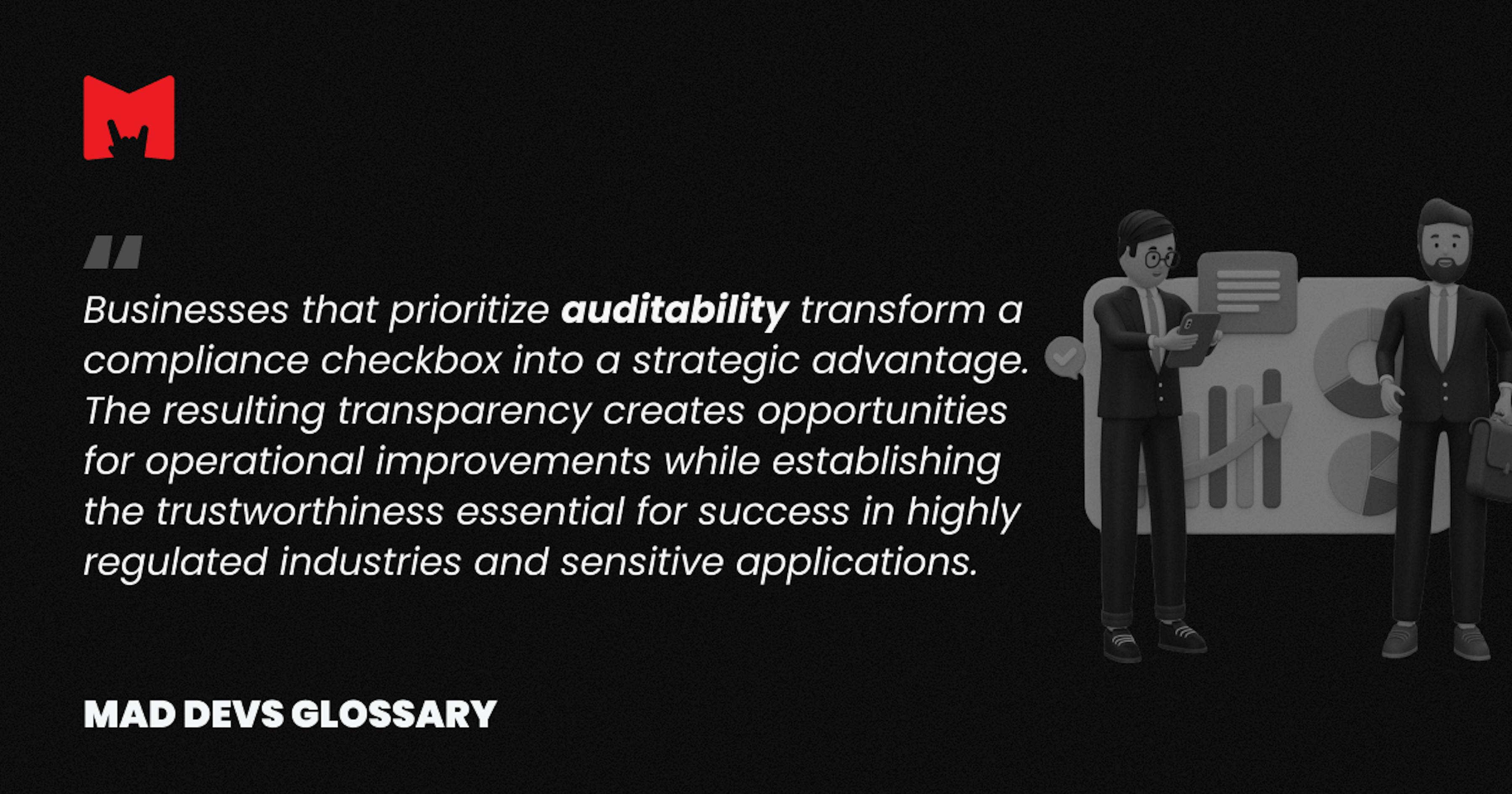
Businesses that prioritize auditability transform a compliance checkbox into a strategic advantage. The resulting transparency creates opportunities for operational improvements while establishing the trustworthiness essential for success in highly regulated industries and sensitive applications.
Auditability requirements checklist
The checklist below groups auditability requirements into six categories. Every mature auditable system should satisfy the items in each category, adapted to its regulatory scope and business context.
1. Logging and audit trail
- Every authentication event (success and failure) is logged
- Every authorization decision on sensitive resources is logged
- Every create, update, and delete on business-critical data is logged with before-and-after values where feasible
- Every administrative action (config changes, user provisioning, deployment) is logged
- Log events are structured (JSON, OpenTelemetry, or equivalent) rather than free-text
- Timestamps are in UTC with millisecond precision, and clocks are synchronized across services
2. Integrity and tamper evidence
- Audit records are stored in append-only or WORM storage
- Cryptographic integrity (hash chains, digital signatures) is applied to sensitive audit records
- The team generating audit logs does not have delete or modify rights on the audit store
- Any tampering attempt triggers an alert
3. Access controls on audit data
- Access to audit logs is itself logged
- Only authorized roles can query audit data
- Separation of duties is enforced between administrators and auditors
- Emergency-access ("break glass") procedures for audit data are documented and reviewed
4. Data lineage and traceability
- Data transformations are traceable from source to output
- User actions can be reconstructed end-to-end across services
- Cross-tenant, cross-region, or cross-system events include correlation IDs
- Batch processes and scheduled jobs identify their originator and trigger
5. Retention and archival
- Retention periods are defined for each log category, aligned with applicable regulations
- Recent logs are online and queryable within seconds
- Older logs are archived to cost-efficient storage with defined restore procedures
- Deletion at end of retention is automated and verified
6. Search, reporting, and governance
- Auditors can search logs by user, resource, time range, and event type
- Standard compliance reports (SOC 2, ISO 27001, HIPAA, PCI DSS as applicable) can be generated from audit data
- Anomalies and integrity failures trigger alerts to security teams
- Regular review of audit coverage happens as part of change management
Not every category needs the same depth. A regulated financial system needs the full checklist; an internal admin tool may only need categories 1, 3, and 5. Right-sizing auditability to the actual regulatory and business context is what turns it from a compliance burden into practical value.
Find where auditability breaks in your system
Auditability depends on logs, access controls, traceability, and change process. Mad Devs' Tech Audit page shows how to find gaps from codebase to cloud and delivery process.
Explore the tech audit scopeAuditability vs observability
Auditability and observability both depend on collecting data about system behavior, and they often share tooling, which is why they get confused. They answer different questions and have different design constraints.
Auditability answers "what happened and who is accountable." Its audience is auditors, security investigators, regulators, and legal teams. Its goals are integrity, non-repudiation, and long retention. Its data is expected to be trustworthy years later, and its access patterns are infrequent but consequential (someone asking a specific question during an incident or audit).
Observability answers "why is the system behaving this way right now." Its audience is engineers, SREs, and product teams. Its goals are real-time diagnostics, performance analysis, and understanding system state. Its data is expected to be actionable within seconds or minutes, and its access patterns are constant (dashboards, alerts, on-call queries).
Where they overlap. Both use structured logs, both benefit from correlation IDs and consistent timestamps, both feed into centralized platforms (Datadog, Splunk, Grafana, OpenTelemetry Collector, cloud-native services). The same log event can serve both purposes if it is structured and stored appropriately.
Where they diverge.
- Retention. Observability data is usually kept for days or weeks (long enough to diagnose recent incidents). Audit data is kept for years.
- Mutability. Observability tools can drop, sample, or aggregate data without concern. Audit data must be preserved intact.
- Integrity guarantees. Observability data is not usually cryptographically protected. Audit data may need hash chains, digital signatures, or WORM storage.
- Access controls. Observability data is broadly accessible to engineering teams. Audit data is often restricted to a small group.
- Cost model. Observability infrastructure optimizes for query speed; audit infrastructure optimizes for cheap long-term storage.
Practical implication. A single logging pipeline can produce both, but the downstream storage and access controls should split. Route event streams into two paths: a hot observability store with short retention and broad access, and a cold audit store with long retention, integrity guarantees, and restricted access. Trying to satisfy both from the same store either makes observability expensive or makes audit data unreliable.
Teams that treat auditability as "we already have observability" tend to discover the gap during their first compliance audit. Teams that treat observability as "we have audit logs" tend to spend more than necessary on hot storage. Recognizing them as distinct disciplines, sharing some tooling but serving different goals, saves both cost and compliance friction.
Mad Devs & auditability
Mad Devs provides extensive IT audits that deliver cost savings, compliance, and many other benefits to businesses.
- 100% visibility into the IT environment: Mad Devs’ consultants explore the strengths and inefficiencies within a company.
- Identify risks in advance: Our experts identify vulnerabilities and configuration issues to avoid downtime, security breaches, and unplanned expenses.
- Strengthen internal IT controls: We review access management, data security, and other policies to provide insights on fixing the gaps and reducing human error.
- IT and business alignment: An assessment of how well your IT setup aligns with business goals to ensure that technology supports your vision.
- Compliance: Mad Devs understands GDPR and HIPAA, and we ensure your practices align with these and other frameworks.
- Future proofing: We look into how well your infrastructure will scale with your business and recommend upgrades to support long-term innovation and flexibility.
Key Takeaways
- Auditability encompasses both technical capabilities and structural characteristics that enable thorough examination of system activities and decisions.
- A software audit trail captures who did what, when, where, why, and how, across authentication, authorization, data access and modification, administrative actions, and system events. Integrity guarantees (append-only storage, WORM, hash chains) are what separate an audit trail from ordinary logging.
- Companies benefit from auditability through enhanced compliance, security, accountability, and stakeholder trust.
- Comprehensive audit trails provide value beyond compliance by supporting troubleshooting, decision-making, and system improvement.
- Auditability requirements group into six categories: logging and audit trail, integrity and tamper evidence, access controls on audit data, data lineage and traceability, retention and archival, and search/reporting/governance. Right-sizing which categories to enforce depends on the regulatory and business context.
- Auditability and observability share tooling but solve different problems. Observability answers "why is the system behaving this way right now" for engineering teams; auditability answers "what happened and who is accountable" for auditors and regulators. A single logging pipeline can feed both, but retention, integrity guarantees, and access controls should diverge downstream.
- Mad Devs provides extensive IT audit services that identify optimization opportunities and cost savings for clients.
