
[The Solo Sentinel: A Practical Guide to Lightweight Audits in the Age of AI]
Analyze with AI
Get AI-powered insights from this Mad Devs tech article:
Introduction: the last line of defense
The moment before a deploy is a unique kind of silence. The feature is built, the tests pass, and the PR is merged. You're one click away from releasing your work into the wild. It's in this quiet pause that a veteran developer feels it: the final, full-system check, that instinct to look over the edge one last time before stepping off.
Why? Because after this click, there's no true "undo." Your code begins interacting with real users, real data, and real business logic. A flaw is no longer a TODO item; it becomes a live incident, a threat to security, or a blow to user trust. This moment is your last clear chance to find what you've missed.
But let's be real: even in the most well-resourced teams, you can find yourself alone at this precipice. Your brilliant colleagues are deep in their own sprints. Scheduling a comprehensive, synchronous human review would mean missing the window. A professional external audit is a gold-standard option, but it's a project in itself: time-consuming and costly, often reserved for major milestones, not this Tuesday's critical push.
So, you rely on yourself. And that's the trap. You're battling your own brain's "blind spot", the ingrained vision of how the code should work, which makes it incredibly hard to see how it actually does. You're tired from the final push. The deadline looms. This is how subtle, critical bugs slip through the most dedicated solo reviews.
This guide is not about cutting corners. It's about adding a new, powerful layer to your process. It's for that exact scenario when you, as the final gatekeeper, need an instant, unbiased, and hyper-detailed second opinion. The kind that doesn't need to be scheduled, doesn't get tired, and sees your code with fresh eyes.
That second opinion is a large language model (LLM). Think of it not as an AI pair programmer, but as an AI auditor-in-training. Its superpower is its lack of context: it sees your project "for the first time," every single time. It reads code with exhausting precision, tracing execution branches you might gloss over. But it has a crucial limitation: it doesn't know what's important. You have to tell it.
That's the core philosophy of this method. An audit isn't a bug hunt; it's a systematic verification against purpose and criteria. With an LLM, your role shifts from doing the audit to orchestrating it. You become the Audit Lead, defining the objectives (does this serve the business goal?), setting non-negotiable priorities (security and bottlenecks), and expertly interpreting the raw findings.
Consider this your manual for that "pre-launch panic" moment, transforming it from anxiety into a structured, confident, and highly effective verification checkpoint. Whether you're a startup founder shipping solo, a senior engineer owning a critical service, or part of a team where you're the last one looking, this is how you build a smarter guardrail.
This is how you stand sentinel.
Framing your AI auditor: beyond "Check this code"
Think of your LLM as a brilliant but utterly naive intern. Hand it a codebase and say "find problems," and you'll get a flood of observations, from critical security holes to opinions about variable naming in a utility function. Without direction, the effort is wasted.
Your primary task is not to review code; it's to build the context and set the rules of engagement. You are the audit lead briefing your team. A successful audit prompt isn't a question; it's a mini-specification. It should consist of four foundational pillars:
1. The сontext: setting the stage
This is your project's briefing. The LLM has no prior knowledge, so you must provide it.
- Objective: "You are performing a critical pre-deployment security and quality audit of a Node.js/Express API service that handles user authentication and payment processing."
- Scope: "Focus on the
/src/routes/auth.jsand/src/routes/payments.jsmodules. Ignore thetests/andscripts/directories." - Goal: "The goal is to ensure the service is robust, secure, and free of critical flaws before production deployment."
2. The role: defining the persona
This is a psychological hack that dramatically improves output quality. You're not talking to a model; you're briefing a professional.
- Example framing: "You are a Senior Security Engineer with 15 years of experience in web application penetration testing and secure code review. You are known for being meticulous and having a zero-tolerance policy for security risks. You are the final gatekeeper before this code goes live to millions of users."
3. The criteria: what are we actually looking for?
This is the core of your audit specification. You must explicitly define the "checklist." Based on your materials, the priority is clear:
- Primary – business logic & correctness: Does the code actually do what it's supposed to? Look for flawed algorithms, race conditions, incorrect data transformations, and edge cases that break core functionality.
- Non-negotiable – security: This is the main event. Instruct the LLM to search for OWASP Top 10 vulnerabilities (injection, broken auth, sensitive data exposure), insecure dependencies, misconfigurations, and logic flaws that could be exploited.
- Secondary – code health & maintainability: Identify anti-patterns, performance bottlenecks, poor error handling, and violations of the project's own conventions.
4. The format: demanding actionable output
This is what turns raw observations into a workable report. You must define the exact structure.
### # [Critical/High/Medium/Low] Brief Title of the Issue
**Source:** `path/to/file.js:lines 25-30`
**Description:** A clear, concise explanation of the problem found in the code.
**Impact:** What could happen if this is not fixed? (e.g., "This could lead to a full database compromise via SQL injection" or "This causes the payment flow to fail silently for users.")
To visualize how these four pillars work together to create a single, powerful instruction, see the following structure:
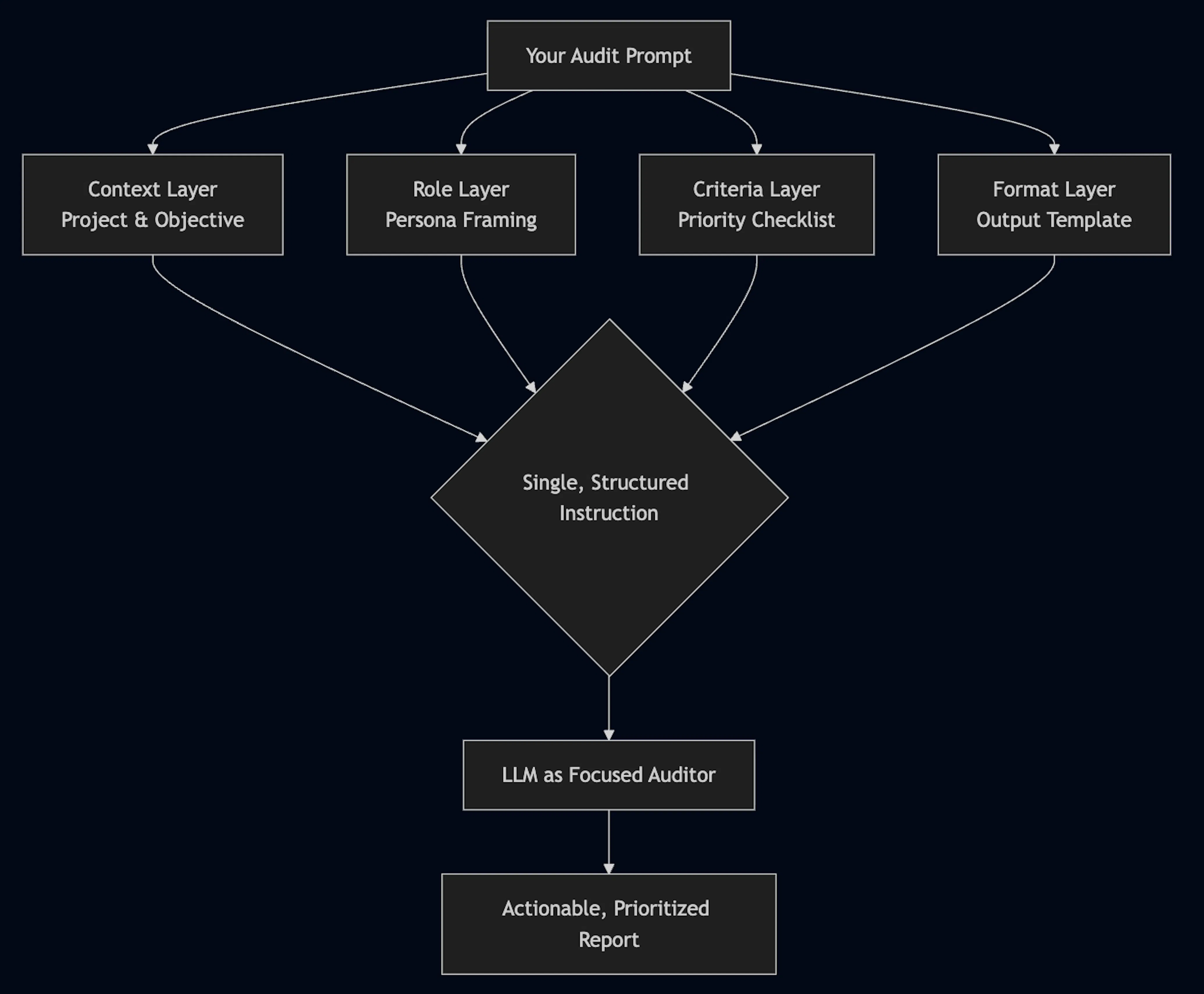
Why this structure wins:
It forces you, the human, to think like an auditor before a single line is reviewed. You are defining "success" and "failure." The LLM becomes a hyper-efficient execution engine for your plan. It provides unbiased scrutiny, while you provide crucial context and judgment. Without this structure, you're just asking for commentary. With it, you're conducting a formal review.
In the next section, we'll put this into action and walk through the step-by-step workflow, from preparing your codebase to analyzing the final report.
The practical workflow: execution & analysis
Theory is set. Now, let's turn it into concrete, repeatable actions. This process is split into two distinct phases: Launching the Audit and Analyzing the Results. Your role switches from architect to executor and then to judge.
Phase 1: Launching the audit
This phase is about preparation and precise execution. Your goal is to get a structured report without wasting resources or risking sensitive data.
1. Code & environment prep
- The biggest enemy of an audit is a moving target. Never run an audit on code that is actively being changed. Clone the repo into a separate directory or check out a fixed commit. This ensures line references in the report remain valid and allows you to work in parallel.
- Ensure files containing credentials, passwords, API keys, or tokens (.env, config/secrets.*) are excluded from the audit scope. Temporarily removing them is the safest practice.
- Consider using packing tools like Gitingest or RepoMix. They package relevant code into a single LLM-friendly file, which can reduce token costs and speed up analysis.
- Before or in parallel to the LLM audit, run dedicated static analysis tools like Trivy, Semgrep, or a tool-based npm audit (or similar for your stack). These tools are unbeatable at finding known vulnerabilities in dependencies, misconfigurations in Dockerfiles, and hardcoded secrets. Crucially, you can feed their output to your LLM agent. Simply add a note to your prompt: "Attached is a vulnerability report from Trivy. Use it as context. Focus your audit on logic flaws and security issues not covered by these automated scans." This creates a powerful, layered defense.
2. The core artifact: the launch prompt
This is the heart of the process. Here is a comprehensive, ready-to-adapt prompt that incorporates all the principles from the previous section.
You are performing a critical pre-deployment security and quality audit for a [Node.js/Express] application. The scope of this audit is limited to the following directories: [src/routes/, src/services/]. Ignore all files in [tests/, scripts/, config/].

**Your Role:** You are a senior security engineer and staff developer with over 15 years of experience. You are known for your meticulous attention to detail and zero-tolerance approach to security risks. You are the final gatekeeper before this code is deployed to production.

**Audit Criteria (in order of priority):**
1.  **Business Logic & Correctness:** Identify flaws in core logic, race conditions, incorrect data handling, and edge cases that could break key user flows (e.g., user registration, payment processing).
2.  **Security:** Identify all potential security vulnerabilities. Focus on OWASP Top 10 (injection, broken authentication, sensitive data exposure, XXE, broken access control, security misconfigurations, XSS, insecure deserialization, vulnerable components, insufficient logging). Pay special attention to data validation, authentication/authorization logic, and dependency versions.
3.  **Code Quality & Maintainability:** Identify performance bottlenecks, anti-patterns, poor error handling, and significant deviations from standard conventions.

**Output Format:** Write the full report to a file named `AUDIT_REPORT.md`. For each finding, use the following template strictly:

### # [Critical/High/Medium/Low] Brief, Descriptive Title
**Source location:** `path/to/file.js:lines 15-30`
**Description:** A clear, concise explanation of the problem found in the code. Reference specific variables or logic.
**Impact and possible consequences:** Explain what could go wrong in production. Be specific (e.g., "This could lead to unauthorized access to all user accounts," not just "security issue").

*Possible severity for your reference:*
- **Critical:** Requires immediate attention before deployment. Direct, exploitable security threat or system-breaking bug.
- **High:** Needs to be solved in the short-term. Serious security concern or major functional flaw.
- **Medium:** Should be addressed in the mid-term. Security hardening or significant code improvement.
- **Low:** Can be addressed in the long-term. Code smell or minor improvement that does not affect function or security.

**Now, begin the comprehensive audit.**
Key launch notes:
- Agent mode is your friend: if your IDE (e.g., Cursor) or platform (e.g., Claude) supports an agent/worker mode, use it. You can run the audit in the background while continuing other work: maximum efficiency.
- The file as an artifact: the requirement to write the report directly to a file (AUDIT_REPORT.md) protects you from losing results if the session crashes.
Phase 2: Analyzing the results
You have a report. Now comes the most critical phase, where your human judgment is the primary tool. Remember: The LLM provides the unbiased scrutiny, but you provide the context and wisdom.
- Embrace the noise. As with any human-led audit, roughly 50% of findings may be noise: false positives, trivialities, or opinions not applicable to your context. This is normal.
- The three-pass triage:
◻️ Pass 1: Relevance check. Quickly scan each item. Does the LLM understand the code's context? Does the problem exist on the cited lines? If not, discard.
◻️ Pass 2: Severity reassessment. LLMs are often wrong about severity. You must re-evaluate each finding based on its real impact on your project. The developer's question: "What happens if we deploy with this specific issue?"
⠀▫️ Critical/High: Blocks deployment. A direct security threat or a show-stopping bug in a core feature.
⠀▫️ Medium/Low: Does not block deployment. Schedule the fix. It could be an architectural suggestion or a minor bug in a non-critical path.
◻️ Pass 3: Focus on what truly matters. Channel your energy into findings that actually impact the business. Priority order: user data security, integrity of payment transactions, and availability of the core service. - The final judgment call. This is not an LLM vote. It's your engineering decision.
◻️ If there is a single сritical finding related to security or core functionality, deployment is blocked. Full stop.
◻️ For high-priority items, assess if they can be fixed in minutes. If yes, fix them. If not, weigh the risk and schedule the fix as the very first post-deploy task.
◻️ Everything else (medium, low, noise) goes into the technical debt log. You have acknowledged the external feedback and made a conscious decision to proceed.
This two-phase approach turns the raw output from the LLM into a clear, actionable plan, enabling you to make an informed and confident step toward deployment.
Mindset & best practices: the auditor's wisdom
Adopting this AI-assisted audit method isn't just about learning a new prompt, but rather about embracing a fundamental shift in your role as a developer. You're no longer just the author of code; you are increasingly its primary verifier, risk manager, and final quality gate. This mindset and a set of sustainable practices are what transform a useful technique into a professional superpower.
The strategic mindset: augmentation, not replacement
The most critical mental model to adopt is that of orchestration. The LLM is an incredibly capable but context-blind instrument. You are the conductor. Your value is no longer in manually checking every line (the machine is better at that), but in:
- Defining "сorrectness": You set the standards for security, business logic, and quality that the code must meet.
- Asking the right questions: You frame the audit's scope and priorities based on business impact.
- Making the judgment call: You interpret the machine's findings with human wisdom and context, separating critical threats from acceptable noise.
This is a move up the value chain. It frees you from tedious, repetitive scrutiny and elevates your focus to system design, risk assessment, and strategic decision-making.
Best practices for sustainable audits
To make this practice a natural part of your workflow, consider these guidelines:
- Integrate at key milestones: don't save it only for panicked pre-deploy moments. Use it before major merges, when taking over legacy code, or as a final check on a dependency upgrade. It's a versatile checkpoint.
- Curate your own prompt library: build a collection of proven audit prompts for different scenarios: a quick security sweep, a full-stack review, and a dependency health check. This turns setup time into a near-zero effort.
- Embrace the "noise floor": accept that a significant portion of the findings will be irrelevant. Your skill is not in eliminating this noise through perfect prompting but in efficiently filtering it through the triage process we defined.
- Use it for self-education: treat surprising or confusing findings as learning opportunities. Ask the LLM to explain a vulnerability or a better pattern. The audit becomes a tool for continuous skill development.
- Know when to escalate: this method is superb for catching implementation flaws and common vulnerabilities. It is weak at evaluating high-level architecture, business logic feasibility, or novel security threats. For these, human experts and formal processes are still irreplaceable. Use the LLM to ensure the foundation is solid before bringing in a human expert to evaluate the structure.
The unchanging core
Technology evolves, but core principles endure. In the age of AI-generated code, the bottleneck has shifted from writing to verification. The ultimate responsibility of the engineer, to understand the system, to vouch for its safety, and to ensure it serves its purpose, remains unchanged and undiminished. This method doesn't absolve you of that responsibility; it equips you to fulfill it more thoroughly when working alone.
Final thought: your new guardrail
Deploying code will always carry a weight of responsibility. This AI-assisted audit process builds a robust, automated guardrail into your workflow, a guardrail that works at machine speed but is guided by human priorities.
It turns the solitary act of final verification from a stressful, hope-based gamble into a structured, evidence-based ritual. You are not just checking a box; you are gathering proof of integrity before leaping.
Start small. Take your next side project or a non-critical service and run it through this full cycle. Refine your prompts. Feel the difference between anxious guessing and informed confidence. Then scale the practice.
The goal is not perfect code but deployable confidence. And now, you have a powerful way to earn it.